


Sustainability in maritime freight transport is one of the sector’s greatest challenges, and since this year, it has also become a legal obligation. On September 30, shipping companies operating in the European Union, Iceland, or Norway made their first payment corresponding to greenhouse gas emission allowances, under the EU Emissions Trading System (ETS). In total, about 2.9 billion USD, according to consultancy Drewry’s analysis, as a result of the 90 million tons of CO₂ emitted in 2024 by the nearly 13,000 vessels that reported data to the emissions Monitoring, Reporting, and Verification (MRV) platform.
What Is the EU Emissions Trading System?
Since 2018, maritime operators have been required to monitor and report their ships’ pollutant emissions. With the goal of promoting sustainability in maritime freight transport, the EU adopted Regulation 2023/957 in May 2023, which amended Regulation 2015/757 to incorporate maritime transport into the EU Emissions Trading System starting in January 2024.
Through this system—operating since 2005 as the world’s first carbon market—companies must monitor and report their legally limited pollutant emissions. Those whose annual emissions remain below the permitted cap can sell their surplus allowances, while those expecting to exceed the limit can purchase additional emission rights at auction. Companies that fail to comply face heavy fines. The revenue collected from emission rights is distributed among Member States to finance policies contributing to the green transition.
The EU’s emission reduction targets are becoming increasingly strict. Following the 2023 review, the aim is to achieve a 62 % reduction by 2030 compared to 2005 levels.
Gradual Integration into the Emissions Control System
Shipping companies are being incorporated into the system progressively. Each year, they must submit a verified emissions report for each vessel over 400 gross tons, as well as an aggregated company-wide report. In this first year, covering 2024 emissions, 40 % are subject to charges. Next year, the rate will increase to 70 %, and from 2027 onward, companies will have to pay for 100 % of their emissions.
Given the current CO₂ price of €70 per ton, Drewry warns that, assuming the same emission levels, shipping companies will face payments of 7.5 billion USD in 2027. It should also be noted that the international geopolitical situation has forced cargo vessels to take longer routes to avoid the Suez Canal, leading to a 14 % increase in emissions.
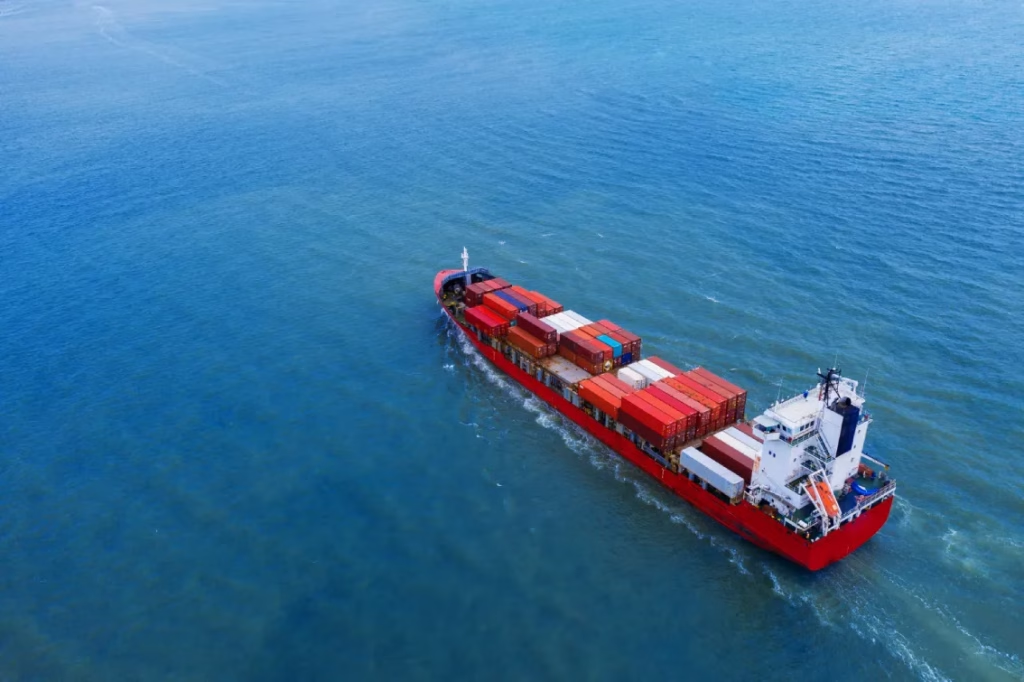
Container ships account for 34 % of total emissions, even though they make up only 16 % of the fleet. On average, each container ship must pay 0.5 million USD for CO₂ emissions, while RoPax and passenger vessels face double that amount.
Sustainability in Maritime Freight Transport
This new tax burden is prompting major shipping companies to offer greener services in order to reduce shipping costs and promote sustainability in maritime freight transport.
Environmental protection and the promotion of practices that help combat climate change are part of Startrans’ core values. We have a sustainability policy aligned with the United Nations Sustainable Development Goals (SDGs), which includes among its general principles the promotion of climate action by fostering the reduction of greenhouse gas emissions in the course of our operations.
Contact us to find out how to make your shipments as environmentally friendly as possible.